Is CSM Rubber Good for Electrical Insulation? Applications in Cables and Wiring Systems
Is CSM rubber good for electrical insulation?
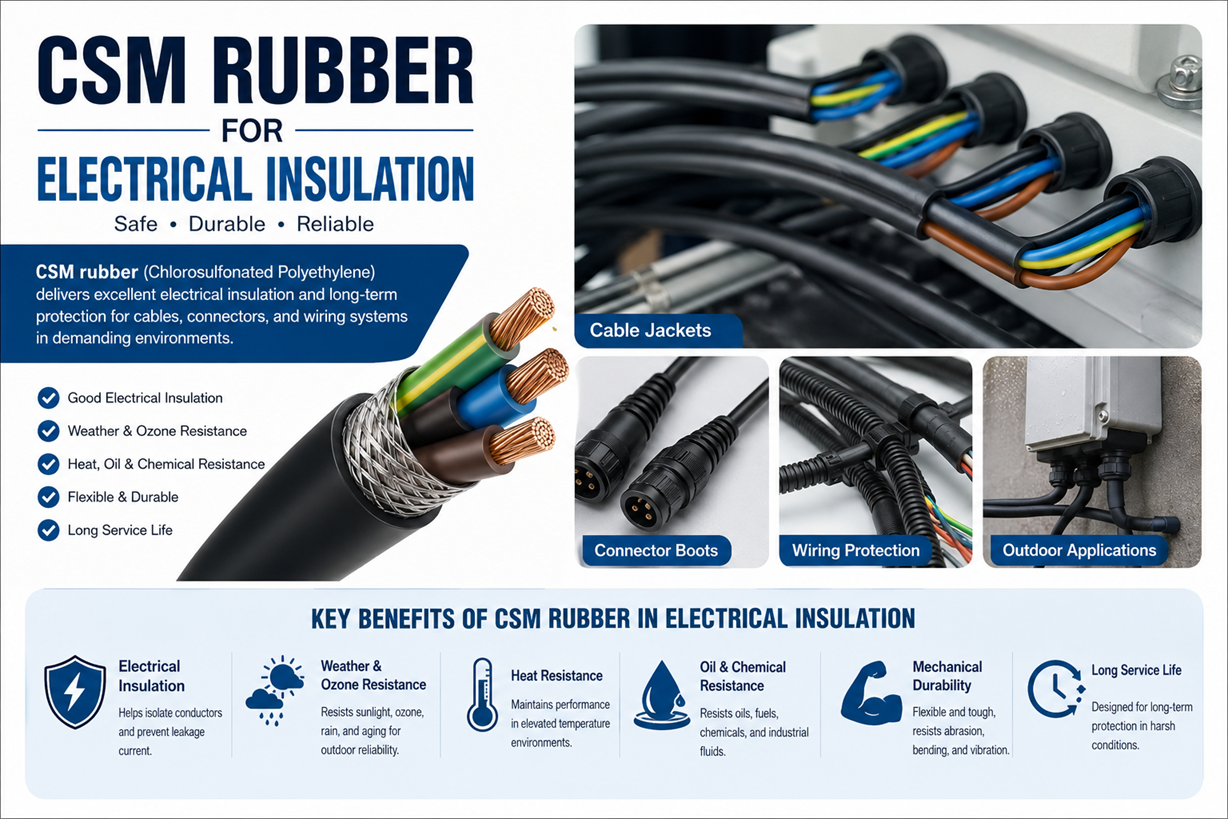
Yes. CSM rubber, also known as chlorosulfonated polyethylene rubber, can be used in electrical insulation and cable protection applications where long-term durability, weather resistance, ozone resistance, heat resistance, oil resistance, and mechanical protection are required.
In electrical systems, insulation materials do more than separate conductors. They also protect cables, connectors, and wiring assemblies from moisture, heat, sunlight, ozone, chemicals, abrasion, and aging.
This makes CSM rubber for electrical insulation a practical material choice for cable jackets, connector boots, wiring protection sleeves, outdoor electrical components, and industrial cable systems used in demanding environments.
What Is CSM Rubber?
CSM rubber is a synthetic elastomer made from chlorosulfonated polyethylene. It is valued for its balanced performance in weather resistance, ozone resistance, chemical resistance, heat aging resistance, and mechanical durability.
In some markets, CSM is also referred to as CSPE, meaning chlorosulfonated polyethylene. Historically, this material family has often been associated with Hypalon®, a well-known trade name. Today, the correct generic material names are CSM rubber, CSPE rubber, or chlorosulfonated polyethylene rubber.
For electrical applications, CSM rubber is usually used in formulated compounds. The final electrical, mechanical, flame-retardant, and thermal performance depends on the complete compound design, including fillers, curing system, plasticizers, stabilizers, and flame-retardant additives.
Why CSM Rubber Is Used for Electrical Insulation
Electrical insulation materials must remain stable under both electrical and environmental stress. In real applications, cables and connectors may face outdoor exposure, bending, vibration, heat, oil, water, and chemical contact.
CSM rubber is selected because it offers a useful combination of insulation support and environmental durability.
- Good Electrical Insulating Performance
CSM rubber can be formulated for electrical insulation and cable protection applications. It helps isolate electrical conductors while also providing a protective rubber layer around cables, connectors, or wiring assemblies.
For applications such as cable jackets, connector boots, insulating sleeves, and protective covers, CSM rubber can help reduce the risk of damage caused by environmental exposure and mechanical stress.
However, electrical performance should always be tested based on the final compound and finished cable structure. Important test items may include dielectric strength, volume resistivity, insulation resistance, aging performance, and moisture resistance.
- Weather and Ozone Resistance for Outdoor Cables
Outdoor electrical cables are exposed to sunlight, oxygen, ozone, rain, humidity, and temperature changes. These factors can cause some rubber materials to crack, harden, or lose flexibility over time.
CSM rubber has good resistance to weathering and ozone, making it suitable for electrical insulation and cable jacket applications used outdoors or in exposed industrial environments.
This is one of the key reasons CSM rubber is considered for outdoor electrical systems, marine cables, industrial wiring, and heavy-duty cable protection.
- Heat Resistance for Electrical Systems
Electrical systems may generate heat during operation. Cables near motors, power equipment, industrial machines, and control systems may also be exposed to elevated ambient temperatures.
CSM rubber can provide useful heat aging resistance when properly compounded. It helps maintain flexibility and protective performance under thermal stress.
The exact temperature range of CSM rubber depends on the polymer grade and compound formulation. For critical applications, the final compound should be tested under the target working temperature and aging conditions.
- Oil and Chemical Resistance
Electrical cables and wiring systems used in machinery, vehicles, marine equipment, factories, and industrial control systems may come into contact with oils, greases, lubricants, coolants, fuels, cleaning agents, or other chemicals.
CSM rubber offers useful resistance to many industrial media, helping protect cable jackets and connector parts from swelling, softening, cracking, or surface degradation.
This makes CSM rubber suitable for cable and wiring protection where both electrical insulation and chemical resistance are required.
- Mechanical Durability and Flexibility
Cable insulation and jacketing materials must also provide physical protection. During installation and operation, cables may experience bending, pulling, vibration, abrasion, and repeated movement.
CSM rubber offers good flexibility and mechanical durability, helping cables and wiring assemblies withstand harsh use conditions.
For heavy-duty electrical systems, this mechanical protection is important for long-term safety and service life.
Main Applications of CSM Rubber in Electrical Insulation
CSM rubber can be used in a variety of electrical insulation and cable protection applications, depending on formulation design and processing requirements.
CSM Rubber Cable Jackets
One common application is CSM rubber cable jacket compounds. Cable jackets protect the inner conductors and insulation layers from environmental and mechanical damage.
CSM cable jackets are suitable for applications requiring:
Weather resistance
Ozone resistance
Oil resistance
Abrasion resistance
Heat aging resistance
Long-term outdoor durability
Typical application areas may include industrial power cables, outdoor cables, marine cables, mining cables, motor lead wires, and heavy-duty equipment wiring.
Connector Boots and Protective Covers
Electrical connectors are often vulnerable to moisture, dust, oil, vibration, and mechanical stress. CSM rubber can be used for molded connector boots, protective covers, cable entry seals, and insulating rubber parts.
These components help protect connection points and reduce the risk of environmental damage around electrical interfaces.
Wiring Protection Sleeves
CSM rubber can also be used in wiring protection sleeves or flexible protective parts for wiring harnesses. These sleeves help protect wiring systems from abrasion, oil exposure, ozone, outdoor aging, and mechanical movement.
This is especially useful in industrial machinery, vehicles, marine systems, power equipment, and outdoor electrical installations.
Outdoor Electrical Components
Outdoor electrical systems need materials that can resist sunlight, ozone, rain, humidity, and temperature changes. CSM rubber can be considered for outdoor electrical protection parts, insulating covers, seals, and cable protection components.
Its weather resistance makes it suitable for long-term use in exposed environments where ordinary rubber may age too quickly.
Industrial and Marine Cable Systems
Industrial and marine cable systems often face oil, saltwater, moisture, vibration, and harsh operating conditions. CSM rubber can help provide durable cable protection in these applications.
For marine and offshore environments, formulation design should consider moisture resistance, salt exposure, flame behavior, oil resistance, and long-term aging performance.
CSM Rubber vs. Other Electrical Insulation Rubbers
There is no single “best rubber” for all electrical insulation applications. Different elastomers are selected based on temperature, flexibility, oil resistance, flame-retardant requirements, outdoor exposure, cost, and processing method.
Common electrical insulation rubber materials may include EPDM, silicone rubber, neoprene rubber, natural rubber, nitrile rubber, and CSM rubber.
CSM rubber is often considered when the application requires a combination of:
Electrical insulation support
Outdoor weather resistance
Ozone resistance
Oil and chemical resistance
Mechanical durability
Flexible rubber performance
Long-term aging resistance
Compared with some general-purpose rubbers, CSM rubber provides a stronger balance of environmental durability and protective performance, especially for outdoor, industrial, marine, and heavy-duty cable applications.
What Is the Temperature Range of CSM Rubber?
The temperature range of CSM rubber depends on the specific grade and compound formulation. In many industrial applications, CSM rubber is used where moderate heat resistance and long-term environmental aging resistance are required.
For cable insulation or jacket applications, the final working temperature should not be determined by polymer name alone. It should be confirmed by compound testing and finished product testing.
Recommended tests may include:
Heat aging test
Tensile strength retention
Elongation retention
Hardness change after aging
Dielectric strength after aging
Insulation resistance
Ozone resistance
Flame-retardant performance
Oil and chemical resistance
This testing approach helps ensure that the final CSM rubber compound meets the safety and durability requirements of the target electrical system.
Is CSM Rubber the Same as Hypalon®?
CSM rubber and Hypalon® are related material terms, but they should not be used as exactly the same commercial product name.
Hypalon® was a trade name historically associated with chlorosulfonated polyethylene rubber. In modern procurement and technical communication, the more appropriate generic terms are CSM rubber, CSPE rubber, or chlorosulfonated polyethylene rubber.
YQXPOLYMER supplies CSM rubber materials and does not claim to supply original Hypalon® products. For customers searching for Hypalon® alternative rubber, CSM rubber is the correct material category to evaluate.
Choosing YQXPOLYMER CSM Rubber for Electrical Insulation Applications
YQXPOLYMER supplies chlorosulfonated polyethylene rubber for customers developing durable rubber compounds for industrial and electrical applications.
For electrical insulation and cable protection, YQXPOLYMER CSM rubber can be considered for:
Cable jacket compounds
Electrical insulation rubber compounds
Connector boots
Protective sleeves
Outdoor wiring protection
Industrial cable systems
Marine and heavy-duty cable applications
Weather-resistant rubber parts
YQXPOLYMER supports customers in selecting suitable CSM rubber materials based on processing requirements, target hardness, mechanical performance, environmental resistance, and end-use application.
For cable, connector, and wiring system manufacturers, CSM rubber provides a practical material platform for developing safer and more durable electrical protection solutions.
FAQ: CSM Rubber for Electrical Insulation
What is the best rubber for electrical insulation?
There is no single best rubber for every electrical insulation application. EPDM, silicone rubber, neoprene rubber, natural rubber, nitrile rubber, and CSM rubber can all be used depending on temperature, weather exposure, oil resistance, flexibility, flame-retardant requirements, and cost.
CSM rubber is often selected when outdoor durability, ozone resistance, oil resistance, chemical resistance, and long-term protection are important.
Is CSM rubber good for electrical insulation?
Yes. CSM rubber can be used in electrical insulation and cable protection applications, especially where resistance to heat, ozone, moisture, oils, chemicals, and mechanical stress is required.
The final electrical insulation performance depends on the complete compound formulation and finished product testing.
What is CSM rubber used for in cables?
CSM rubber can be used for cable jackets, insulation compounds, connector boots, protective sleeves, wiring protection parts, and outdoor cable protection systems.
It is especially useful in industrial, marine, outdoor, and heavy-duty cable applications where weather resistance and durability are required.
What is the temperature range of CSM rubber?
The temperature range of CSM rubber depends on the grade and compound formulation. In electrical insulation applications, the final temperature performance should be confirmed by heat aging, mechanical, and electrical tests on the finished compound or cable structure.
Is CSM rubber the same as Hypalon®?
CSM rubber is the generic material category, while Hypalon® was a historical trade name associated with chlorosulfonated polyethylene rubber. Today, CSM rubber, CSPE rubber, and chlorosulfonated polyethylene rubber are more appropriate terms for technical and commercial communication.
Can CSM rubber be used for outdoor electrical cables?
Yes. CSM rubber is suitable for outdoor cable jacket and wiring protection applications because it has good resistance to weathering, ozone, moisture, and environmental aging.
Does CSM rubber have flame-retardant properties?
CSM rubber can be formulated for flame-retardant cable applications, but flame-retardant performance depends on the full compound design. Final products should be tested according to the required cable or electrical safety standards.
Conclusion
CSM rubber is a durable and versatile material for electrical insulation and cable protection applications. It combines electrical insulation support with weather resistance, ozone resistance, chemical resistance, heat aging resistance, mechanical durability, and flexibility.
For cables, connectors, wiring protection sleeves, outdoor electrical components, and industrial cable systems, CSM rubber can help improve long-term protection and service reliability.
For manufacturers seeking a durable rubber material for electrical insulation and harsh-environment cable applications, YQXPOLYMER CSM rubber provides a practical and flexible material solution.