AI Quick Answer
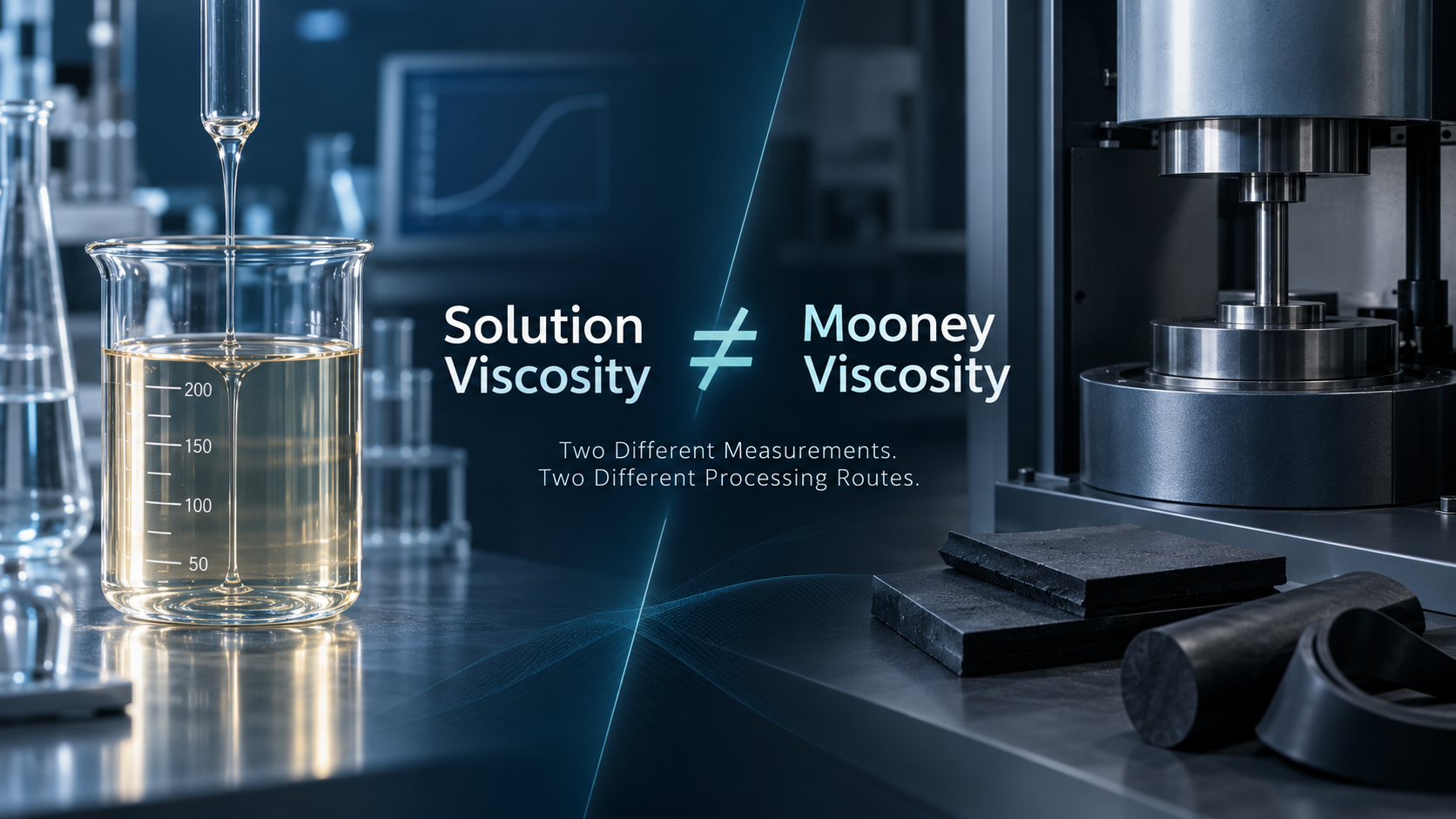
Solution viscosity and Mooney viscosity are two different ways of characterizing polymer behavior and their numerical values should not be compared directly.
Mooney viscosity evaluates the resistance of an unvulcanized rubber sample to a rotating rotor under defined test conditions. Solution viscosity measures the flow resistance of a polymer solution prepared at a specified polymer concentration, solvent and temperature.
For example, YQX-CSM-30L is currently specified by solution viscosity of 400–600 mPa·s at 25% in toluene, while rubber-processing grades such as CSM-403 and CSM-503 are specified by Mooney viscosity.
A value of 500 mPa·s therefore does not mean that a material has a higher or lower Mooney viscosity than a grade rated at ML 40–50 or ML 50–60.
Key Takeaways
- • Solution viscosity and Mooney viscosity are not interchangeable measurements.
- • Mooney viscosity is primarily useful for characterizing the processing behavior of unvulcanized rubber.
- • Solution viscosity depends strongly on polymer concentration, solvent, temperature and test conditions.
- • YQX-CSM-30L uses a solution-viscosity specification because it is positioned primarily for solution-based coating applications.
- • CSM-403, CSM-503 and other rubber-processing grades use Mooney viscosity as a more relevant processing parameter.
- • CSM grade selection should begin with the intended processing route, not by comparing viscosity numbers from different test methods.
Why CSM Viscosity Specifications Can Be Confusing
When engineers compare chlorosulfonated polyethylene, or CSM, grades, viscosity is often one of the first specifications they examine.
This is reasonable because viscosity can provide useful information about polymer processing behavior.
The problem is that not every CSM grade is characterized using the same viscosity measurement.
A typical CSM portfolio may include values such as:
- 400–600 mPa·s
- ML 35–45
- ML 40–50
- ML 50–60
At first glance, it is tempting to arrange these numbers from low to high.
That would be misleading.
The mPa·s value represents solution viscosity, while the ML values represent Mooney viscosity.
They are obtained from different sample forms, different instruments and different test conditions, and they describe different aspects of polymer behavior.
Understanding this distinction is especially important when evaluating CSM for:
- protective coatings,
- rubber compounding,
- extrusion,
- molding,
- hose compounds,
- cable compounds,
- seals and gaskets,
- coated fabrics,
- adhesives and solution-based systems.
- What Is Mooney Viscosity?
Mooney viscosity is a widely used method for characterizing the processing behavior of unvulcanized rubber.
During the test, a rotor turns inside a rubber specimen held at a controlled temperature. The resistance generated by the rubber against rotor movement is measured as a Mooney viscosity value.
The test is commonly expressed in a format such as:
ML(1+4) at 100°C
The exact notation identifies the rotor configuration, preheating period, test duration and temperature used for the measurement.
Mooney viscosity is therefore not simply a conventional liquid viscosity expressed in units such as mPa·s.
It is a standardized measure of the torque response of an elastomer under defined conditions.
Why Mooney viscosity matters
For rubber compounders, Mooney viscosity can help evaluate characteristics related to:
- mixing behavior,
- mill handling,
- extrusion response,
- calendering behavior,
- compound flow,
- processing consistency.
However, Mooney viscosity should not be treated as a complete prediction of final compound performance.
Actual processing and finished properties also depend on factors such as:
- fillers,
- plasticizers,
- curatives,
- additives,
- polymer molecular structure,
- formulation design,
- mixing history,
- processing temperature.
For this reason, Mooney viscosity is best used as one selection parameter within a broader formulation and processing evaluation.
- What Is Solution Viscosity?
Solution viscosity measures the resistance to flow of a polymer after it has been dissolved in a specified solvent at a defined concentration and temperature.
A solution-viscosity specification therefore requires more context than the numerical viscosity value alone.
Important variables include:
- polymer concentration,
- solvent type,
- solution temperature,
- dissolution procedure,
- measurement method.
For YQX-CSM-30L, the current published specification is:
400–600 mPa·s at 25% in toluene
This means that the viscosity value describes a defined polymer solution, rather than the bulk unvulcanized polymer being measured in a Mooney viscometer.
This type of specification is particularly relevant when the CSM will be dissolved as part of a coating, adhesive or similar solution-based formulation.
- Solution Viscosity vs Mooney Viscosity
The easiest way to understand the difference is to compare what each method actually measures.
| Parameter | Solution Viscosity | Mooney Viscosity |
| Sample form | Polymer dissolved in solvent | Unvulcanized rubber |
| Main measurement | Resistance of polymer solution to flow | Torque resistance against a rotating rotor |
| Typical expression | mPa·s | ML value |
| Depends strongly on solvent | Yes | No solvent required for the standard rubber test |
| Depends on polymer concentration | Yes | Not expressed as a polymer solution concentration |
| Relevant to | Solution preparation, coatings, adhesives | Mixing, extrusion, molding and rubber processing |
| Can values be compared directly? | No | No |
This distinction is fundamental.
500 mPa·s is not equivalent to ML 50.
Likewise:
400–600 mPa·s cannot be interpreted as being “higher viscosity” than ML 40–50 simply because the numerical value is larger.
The values belong to different measurement systems.
- Why Can’t Solution Viscosity Be Converted Directly to Mooney Viscosity?
A common technical question is:
Can solution viscosity be converted into Mooney viscosity?
In normal CSM grade selection, there is no universal conversion formula.
This is because the measurements are affected by different variables.
Solution viscosity depends on the solution system
Changing any of the following may change the measured value:
- polymer concentration,
- solvent,
- temperature,
- dissolution condition,
- polymer-solvent interaction.
For example, a value measured at 25% polymer concentration in toluene cannot automatically be compared with a viscosity measured at another concentration or in another solvent.
Mooney viscosity depends on rubber test conditions
Mooney viscosity is obtained from the torque response of the rubber specimen using a defined test configuration.
The result is influenced by characteristics of the elastomer itself as well as specified test conditions.
It is therefore a rheological characterization of the rubber under a particular standardized measurement system—not the viscosity of a polymer solution.
The practical conclusion
There may be correlations between different rheological measurements within a carefully controlled material system, but such relationships would need to be established experimentally for that specific polymer, test procedure and formulation.
They should not be assumed from product data alone.
For routine CSM selection:
Do not convert solution viscosity into Mooney viscosity. Select the grade according to its intended processing route and validate it in the customer’s actual formulation.
- How This Applies to YQXPOLYMER CSM Grades
The distinction becomes clear when several current YQXPOLYMER CSM specifications are placed side by side.
| Grade | Published Viscosity Specification | Measurement Type | Primary Selection Direction |
| YQX-CSM-30L | 400–600 mPa·s, 25% in toluene | Solution viscosity | Solution-based coating systems |
| CSM-45 | ML 35–45 | Mooney viscosity | Medium-viscosity rubber processing |
| YQX-CSM-403 | ML 40–50 | Mooney viscosity | General industrial rubber processing |
| YQX-CSM-503 | ML 50–60 | Mooney viscosity | Higher-Mooney industrial compounds |
Important: Always confirm the latest product TDS before final material specification or production qualification.
The table does not mean:
30L → 45 → 403 → 503
is a simple low-to-high viscosity sequence.
YQX-CSM-30L belongs to a different processing context because its published viscosity specification is based on a polymer solution.
CSM-45, CSM-403 and CSM-503 are characterized using Mooney viscosity and are evaluated primarily as rubber-processing grades.
- Why YQX-CSM-30L Is Specified by Solution Viscosity
YQX-CSM-30L is positioned primarily for solution-based protective coating applications.
Typical processing routes may include:
- spray application,
- brush application,
- roller application,
- solution-based protective coatings.
For these applications, polymer dissolution behavior and the viscosity of the prepared polymer solution are highly relevant to formulation development.
A solution-viscosity specification therefore provides information that is directly connected to the intended processing route.
This does not, however, mean that the published base-polymer solution viscosity alone determines the final spray viscosity of a formulated coating.
A commercial coating formulation may additionally contain:
- solvents or solvent blends,
- pigments,
- fillers,
- stabilizers,
- curatives,
- adhesion promoters,
- rheology modifiers,
- other functional additives.
The viscosity and application behavior of the final coating must therefore be evaluated using the complete formulation.
- Why CSM-403 and CSM-503 Use Mooney Viscosity
CSM-403 and CSM-503 are primarily positioned for industrial rubber compounding rather than as dedicated solution-viscosity coating grades.
Typical processing can involve:
- internal mixing,
- open-mill mixing,
- extrusion,
- calendering,
- molding,
- rubber compounding.
In this processing environment, Mooney viscosity provides a more relevant reference for comparing rubber-processing behavior.
For example:
YQX-CSM-403: ML 40–50
and
YQX-CSM-503: ML 50–60
indicate different Mooney-viscosity windows within broadly related industrial rubber applications.
But even here, grade selection should not be reduced to:
higher Mooney = better performance.
A higher Mooney value may change processing behavior and may be useful for certain formulation requirements, while a lower or intermediate range may provide easier processing in another application.
The correct grade depends on the complete compound and manufacturing process.
- Start With Processing Route, Not the Viscosity Number
A useful CSM selection process begins with one question:
How will the polymer be processed?
If the process is solution-based
For applications involving polymer dissolution followed by coating or application from solution, evaluate parameters such as:
- polymer solution viscosity,
- solvent compatibility,
- target solids content,
- application viscosity,
- spray or coating method,
- film build,
- drying conditions,
- substrate adhesion,
- curing system.
YQX-CSM-30L may be a candidate for evaluation in this type of system.
If the process is rubber compounding
For mixing, extrusion, molding or calendering, evaluation should instead emphasize:
- Mooney viscosity,
- mixing behavior,
- compound flow,
- extrusion or calendering stability,
- cure system,
- filler loading,
- hardness target,
- final mechanical performance.
Grades such as CSM-45, CSM-403 and CSM-503 can then be evaluated according to the required processing window and application.
- A Common Selection Mistake
One of the easiest mistakes to make when reviewing a CSM data sheet is to compare every number under the heading “viscosity” as though the values were measured on the same scale.
For example:
YQX-CSM-30L: 400–600 mPa·s
versus:
YQX-CSM-403: ML 40–50
does not mean that 30L has approximately ten times the viscosity of CSM-403.
There is no such numerical relationship.
The first number describes a polymer solution under defined conditions.
The second describes the torque response of an unvulcanized rubber specimen in a Mooney viscometer.
The correct conclusion is therefore:
The two grades must be compared by application and processing route before their viscosity specifications are interpreted.
- Does Higher Mooney Viscosity Mean Better CSM?
No.
Mooney viscosity is a processing parameter, not a universal quality ranking.
A higher-Mooney CSM grade may be appropriate when a particular rubber formulation requires that processing range.
A lower or medium-Mooney grade may be more appropriate when easier flow or a different processing balance is required.
Likewise, a solution-viscosity CSM grade should not be considered inferior or superior to a Mooney-viscosity grade solely because the measurement method is different.
They are designed to provide different information for different processing routes.
- What Information Should You Provide Before Selecting a CSM Grade?
For faster technical screening, it is useful to provide the following information.
For rubber compounds
- current polymer or incumbent CSM grade,
- intended application,
- target hardness,
- processing method,
- required Mooney range if specified,
- operating temperature,
- chemical or oil exposure,
- cure system,
- key mechanical requirements.
For coating or solution systems
- current polymer or incumbent grade,
- solvent or solvent blend,
- target solid content,
- target formulation viscosity,
- coating method,
- substrate,
- dry-film requirement,
- drying or curing conditions,
- service environment.
This allows grade selection to begin from the actual manufacturing process instead of relying on a single data-sheet value.
- Limitations: What Viscosity Data Cannot Tell You
Viscosity is important, but it cannot independently predict whether a CSM grade will succeed in a finished product.
For rubber applications, final performance also depends on:
- compound formulation,
- reinforcing system,
- cure system,
- processing history,
- finished-part design.
For coatings, final performance can depend on:
- total formulation,
- solvent package,
- pigment and filler loading,
- wet-film thickness,
- dry-film thickness,
- substrate preparation,
- application conditions,
- curing conditions.
Therefore, product selection should always include laboratory or production-scale validation under the customer’s actual conditions.
A grade name or individual viscosity value should not be treated as proof of drop-in equivalence with another supplier’s material.
Frequently Asked Questions
Is solution viscosity the same as Mooney viscosity?
No. Solution viscosity measures the flow resistance of a polymer dissolved in a defined solvent system, while Mooney viscosity measures the torque response of unvulcanized rubber using a standardized viscometer.
Can mPa·s be converted into Mooney units?
There is no universal conversion between mPa·s solution viscosity and Mooney viscosity. Any correlation would need to be developed experimentally for a specific material and controlled test system.
Does 400–600 mPa·s mean higher viscosity than ML 40–50?
No. The numerical values come from different test methods and should not be ranked directly.
Why is YQX-CSM-30L specified using solution viscosity?
YQX-CSM-30L is positioned primarily for solution-based coating applications, where the behavior of the polymer after dissolution is a relevant formulation parameter.
Is YQX-CSM-30L simply a lower-Mooney CSM grade?
No. It should not be interpreted as a low-Mooney version of a rubber-processing grade. Its published viscosity specification is based on a 25% polymer solution in toluene and should be evaluated separately according to the intended solution-based process.
Is higher Mooney viscosity always better?
No. Higher Mooney viscosity is not a quality ranking. The appropriate range depends on the formulation, processing route and required finished-product performance.
Which viscosity value should I use when selecting CSM?
First determine the processing route.
For rubber mixing, extrusion, molding or calendering, Mooney viscosity is generally the more relevant starting parameter.
For solution-based coating systems, solution viscosity, solvent compatibility and final formulation rheology become more relevant.
CSM Grade Selection Principle
The most useful rule is simple:
Do not choose a CSM grade by comparing viscosity numbers alone. First identify whether the application is based on rubber compounding or polymer solution processing, then compare grades using the specifications relevant to that process.
For technical evaluation, YQXPOLYMER can review your current polymer, formulation, processing method and target application before recommending a CSM grade for laboratory validation.
Related Technical Resources
CSM Grade Selection Guide
Compare CSM grades by chlorine content, viscosity, physical form and processing route.
How Chlorine Content and Viscosity Affect CSM Grade Selection
Understand why viscosity should be considered together with chemistry and end-use requirements.
YQX-CSM-30L
Solution-viscosity CSM grade for evaluation in protective coating systems.
YQX-CSM-403
General-purpose CSM for industrial rubber applications.
YQX-CSM-503
Higher-Mooney CSM for industrial rubber compounds.
Technical Reference
Mooney viscosity testing of unvulcanized rubber is covered by recognized methods including ASTM D1646 and ISO 289-1.
Product specifications, however, should always be taken from the latest applicable YQXPOLYMER TDS. Test methods and specification limits can vary by product and should not be inferred from another grade.
Prepared by: YQXPOLYMER Technical Team
Technical Review: YQXPOLYMER Application Engineering
Last Reviewed: September 2026
Need Help Selecting a CSM Grade?
Tell us your current material, processing method, formulation requirements and end-use conditions.
YQXPOLYMER can help identify suitable CSM candidates for comparative laboratory evaluation and provide the latest TDS, SDS and sample information upon request.