AI Quick Answer
CSM grade selection should not be based on grade number alone. Chlorine content, viscosity, physical form and intended processing route all influence whether a chlorosulfonated polyethylene grade is better suited to rubber compounding, extrusion, molding or protective coating applications.
Within the YQXPOLYMER CSM portfolio, grades such as YQX-CSM-30H, CSM-45, CSM-403 and CSM-503 are characterized using Mooney viscosity, while YQX-CSM-30L is a powder grade specified by solution viscosity for coating-oriented applications.
For final grade selection, these parameters should always be considered together with the required end-use performance and processing method.
Key Takeaways
- Chlorine content is one of the basic chemical differences between CSM grades, but it should not be used as the only selection criterion.
- Viscosity strongly influences processing behavior, especially in mixing, extrusion, molding and compound formulation.
- Mooney viscosity and solution viscosity are different measurements and their numerical values should not be directly compared.
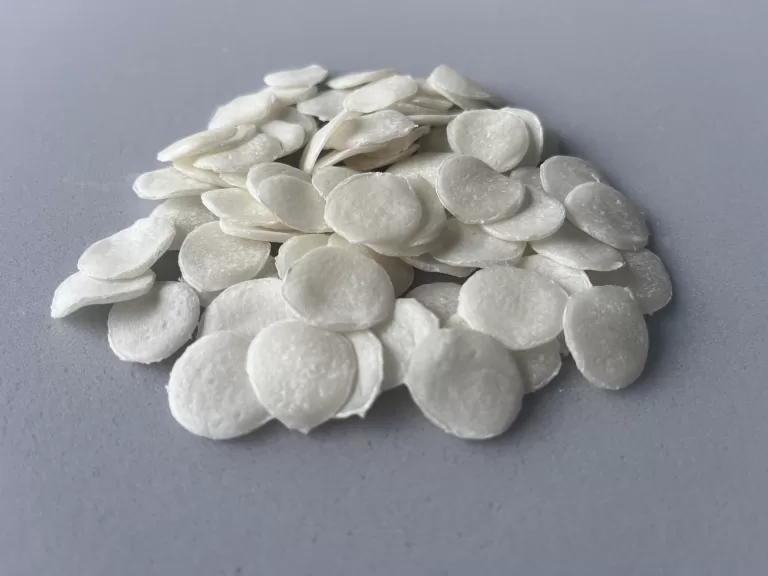
- Physical form matters: flakes, powder, granules and slab grades are intended for different handling and processing routes.
- The best CSM grade is determined by the combination of chemistry + viscosity + processing method + end-use application.
What Determines the Difference Between CSM Grades?
Chlorosulfonated polyethylene, commonly abbreviated as CSM, is available in multiple grades because industrial users do not all process the polymer in the same way.
A compound developed for an industrial hose cover, for example, may require different processing characteristics from a CSM material intended for spray-applied protective coatings.
Four factors are therefore particularly important when comparing CSM grades:
- Chlorine content
- Viscosity
- Physical form
- Intended processing and application route
Looking at these factors together provides a much more useful basis for grade selection than simply comparing product names.
Comparison of Principal YQXPOLYMER CSM Grades
| Grade | Chlorine Content | Sulfur Content | Viscosity | Form | Typical Positioning |
|---|---|---|---|---|---|
| YQX-CSM-30H | 40–43% | 1.1–1.3% | ML 60–90 | Flakes | High-Mooney industrial rubber |
| YQX-CSM-30L | 43 ± 2% | 0.8–1.2% | 400–600 mPa·s, 25% in toluene | Powder | Spray and protective coatings |
| CSM-45 | 25 ± 2% | 1.0–1.5% | ML 35–45 | Granules | Medium-viscosity processing |
| YQX-CSM-403 | 35 ± 2% | 1.0–1.5% | ML 40–50 | Slab | General-purpose industrial rubber |
| YQX-CSM-503 | 35 ± 2% | 1.0–1.5% | ML 50–60 | Granules | Higher-Mooney industrial compounds |
Important: The viscosity specification of YQX-CSM-30L is based on solution viscosity, whereas the other grades listed above use Mooney viscosity. These values represent different test approaches and should not be interpreted as directly equivalent numbers.
1. How Does Chlorine Content Affect CSM Grade Selection?
Chlorine content is one of the most visible differences between CSM grades.
Within the current YQXPOLYMER portfolio, the principal grades cover a relatively broad range:
- CSM-45: 25 ± 2%
- CSM-403: 35 ± 2%
- CSM-503: 35 ± 2%
- YQX-CSM-30H: 40–43%
- YQX-CSM-30L: 43 ± 2%
This variation is important because different grades are designed for different formulation and processing requirements.
However, chlorine content alone does not tell a compounder which grade should be selected.
For example, CSM-403 and CSM-503 both have a nominal chlorine content of approximately 35%, but their Mooney viscosity ranges are different.
CSM-403:
ML 40–50
CSM-503:
ML 50–60
This means two grades with similar chlorine content can still occupy different positions in an industrial formulation.
Practical selection principle
Use chlorine content as a first-level chemical parameter, but always evaluate it together with:
- viscosity
- processing method
- compound design
- application
- required finished-product properties
For customers comparing several grades, see our CSM Grade Selection Guide for a complete grade-by-grade selection overview.
2. Why Is Mooney Viscosity Important for CSM Rubber?
For rubber-processing grades, Mooney viscosity is an important indicator used when evaluating polymer processing behavior.
Within the YQXPOLYMER CSM range, several grades show a clear progression.
CSM-45
Mooney viscosity:
ML 35–45
This is the lowest Mooney range among the principal rubber-processing grades listed here.
Its positioning is therefore centered on medium-viscosity CSM processing, including applications where flexible processing characteristics are required.
Typical applications supported by the current product positioning include:
- industrial rubber products
- hoses
- seals
- wire and cable
- coated fabrics
- adhesives
- automotive applications
- marine applications
CSM-403
Mooney viscosity:
ML 40–50
YQX-CSM-403 is positioned as a general-purpose industrial CSM grade.
Typical applications include:
- industrial hose
- wire and cable
- printing blankets
- conveyor belts
- seals and gaskets
- waterproof membranes
Its moderate Mooney range makes it a useful reference grade when customers need a broadly applicable CSM for industrial rubber compounding.
CSM-503
Mooney viscosity:
ML 50–60
YQX-CSM-503 has approximately the same chlorine range as CSM-403 but a higher Mooney viscosity.
That makes the comparison between these two grades particularly useful.
CSM-403: ML 40–50
CSM-503: ML 50–60
If the application requires a higher-Mooney polymer within a similar chlorine-content range, CSM-503 becomes the more logical grade to evaluate.
For a detailed comparison, see CSM-403 vs CSM-503: How Mooney Viscosity Affects Grade Selection.
YQX-CSM-30H
Mooney viscosity:
ML 60–90
YQX-CSM-30H sits clearly above the other principal grades in the current range in terms of Mooney viscosity.
It is therefore positioned as:
High-Mooney CSM for Industrial Rubber, Hose & Cable
Typical application areas include:
- industrial hose
- cable jacketing
- waterproof membranes
- automotive rubber components
- chemical equipment applications
Customers looking specifically for a high-viscosity CSM grade should evaluate YQX-CSM-30H separately from medium-Mooney grades such as CSM-403 or CSM-503.
3. Why YQX-CSM-30L Should Be Evaluated Differently
YQX-CSM-30L is an important exception within the portfolio.
Unlike 30H, CSM-45, CSM-403 and CSM-503, its current specification is not expressed as Mooney viscosity.
Instead, the TDS specifies:
Solution viscosity: 400–600 mPa·s at 25% in toluene
The product is also supplied in powder form.
This reflects its different application positioning.
YQX-CSM-30L is intended primarily as:
Spray-Grade CSM for Protective Coatings
Supported application and processing routes include:
- airless spray
- HVLP spray
- brush application
- roller application
- marine coatings
- chemical-resistant coatings
- tank linings
- pipe coatings
- bridge protection
- concrete protection
- fuel tank liners
Therefore, it would be misleading to compare “400–600 mPa·s” directly against a Mooney value such as ML 40–50 or ML 60–90.
They are not the same measurement system.
Selection principle
If your process is based on rubber compounding, mixing, extrusion or molding, start by evaluating the Mooney-viscosity grades.
If your process is based on solution preparation and protective coating application, YQX-CSM-30L should be evaluated as a separate coating-oriented grade.
4. Physical Form Also Matters
Polymer chemistry and viscosity are not the only practical considerations.
The current principal YQXPOLYMER grades are supplied in different physical forms:
| Grade | Form |
|---|---|
| YQX-CSM-30H | Flakes |
| YQX-CSM-30L | Powder |
| CSM-45 | Granules |
| CSM-403 | Slab |
| CSM-503 | Granules |
Physical form can influence:
- material handling
- weighing and feeding
- dissolution
- mixing procedure
- production workflow
This is another reason why grade selection should begin with the customer’s actual processing route, not simply a target chlorine content.
5. A Practical CSM Grade Selection Logic
A useful first-stage selection process is:
Choose YQX-CSM-30H when:
You are looking for a high-Mooney CSM grade for demanding industrial rubber compounds such as hose, cable and related rubber applications.
Choose YQX-CSM-30L when:
Your primary process is solution-based coating formulation, especially spray, brush or roller-applied protective coating systems.
Choose CSM-45 when:
You need a medium-viscosity CSM with a lower chlorine-content specification and flexible industrial processing possibilities.
Choose YQX-CSM-403 when:
You need a general-purpose industrial CSM for applications such as hose, cable, seals, conveyor belts or waterproof membranes.
Choose YQX-CSM-503 when:
You need a grade with chemistry close to CSM-403 but higher Mooney viscosity for a more demanding industrial compound.
6. Why One Property Should Never Be Used Alone
A common mistake in CSM sourcing is to compare grades based on only one number.
For example:
“Which grade has the highest chlorine content?”
or:
“Which grade has the highest viscosity?”
These questions are useful, but neither provides enough information for a final material decision.
A more technically useful enquiry should include:
- application
- processing method
- target chlorine range, if specified
- viscosity requirement
- physical form preference
- curing system
- relevant performance requirements
- current or reference grade, if available
With this information, the supplier and customer can narrow the selection much more effectively.
7. Application-Based Selection Examples
Industrial Hose
For industrial rubber hose applications, candidates may include:
- YQX-CSM-30H
- CSM-403
- CSM-503
- CSM-45
The final selection should depend on the compound formulation and required processing behavior rather than the application name alone.
Wire and Cable
CSM is also used in wire and cable applications.
Potential grades include:
- YQX-CSM-30H
- CSM-403
- CSM-45
Again, viscosity and formulation requirements should determine the final choice.
Protective Coatings
For sprayable or solution-based protective coatings, YQX-CSM-30L is the most distinctly positioned grade in the current portfolio.
Its powder form and solution-viscosity specification make it fundamentally different from the principal rubber-processing grades.
Seals and General Industrial Rubber
For seals, gaskets and general industrial rubber compounds, medium-range grades such as CSM-403 and CSM-45 can be considered depending on the formulation.
Where higher Mooney viscosity is required, CSM-503 may also be evaluated.
Limitations of Grade Comparison
The table in this article is intended as a preliminary grade-selection reference, not a substitute for formulation trials.
The listed parameters do not by themselves predict the complete behavior of a finished compound.
Final selection may also depend on:
- fillers
- plasticizers
- curing system
- processing temperature
- mixing conditions
- target hardness
- reinforcement
- other formulation ingredients
- finished-product specifications
Customers should therefore confirm the grade through technical review and, where appropriate, sample testing before commercial production.
Frequently Asked Questions
What is the most important parameter when selecting a CSM grade?
There is no single parameter that determines the correct grade. Chlorine content, viscosity, physical form, processing route and final application should be considered together.
Is higher Mooney viscosity always better?
No. Higher Mooney viscosity represents a different polymer-processing characteristic, not automatically a higher-quality material. The appropriate viscosity depends on the formulation and processing requirements.
Can YQX-CSM-30L viscosity be compared directly with CSM-403 Mooney viscosity?
No. YQX-CSM-30L is specified using solution viscosity, while CSM-403 is specified using Mooney viscosity. These are different measurements and the numerical values should not be directly compared.
What is the difference between CSM-403 and CSM-503?
Both have a chlorine specification of approximately 35 ± 2%, but their Mooney viscosity ranges differ. CSM-403 is ML 40–50, while CSM-503 is ML 50–60. CSM-503 is therefore positioned as the higher-Mooney option.
Which YQXPOLYMER grade is intended for spray coatings?
YQX-CSM-30L is the principal spray-grade CSM in the current portfolio. It is supplied in powder form and is positioned for protective coating applications including airless spray, HVLP, brush and roller application.
Which CSM grade should I use for industrial hose?
YQX-CSM-30H, CSM-403, CSM-503 and CSM-45 may all be relevant depending on formulation and processing requirements. The correct grade should be selected based on more than the application name alone.
Related CSM Resources
For more detailed product and selection information, explore:
CSM Rubber / Chlorosulfonated Polyethylene
Overview of YQXPOLYMER’s CSM material portfolio.
CSM Grade Selection Guide
Compare YQX-CSM-30H, YQX-CSM-30L, CSM-45, CSM-403 and CSM-503 by chemistry, viscosity, physical form and application.
YQX-CSM-30H
High-Mooney CSM for industrial rubber, hose and cable applications.
YQX-CSM-30L
Spray-grade CSM for protective coating systems.
CSM-45
Medium-viscosity CSM for flexible industrial processing.
YQX-CSM-403
General-purpose CSM for hose, cable, seals and industrial rubber.
YQX-CSM-503
Higher-Mooney CSM for demanding industrial compounds.
Need Help Selecting a CSM Grade?
Selecting the right CSM grade starts with understanding the application and processing conditions.
Send the YQXPOLYMER technical team your:
- application
- current/reference grade
- processing method
- required viscosity
- chlorine-content requirement
- target specifications
Our team can help identify the most appropriate CSM grade for initial evaluation and sample testing.
Contact YQXPOLYMER Technical Team
Prepared by: YQXPOLYMER Technical Team
Technical Review: YQXPOLYMER Application Engineering
Last Reviewed: September 2026